
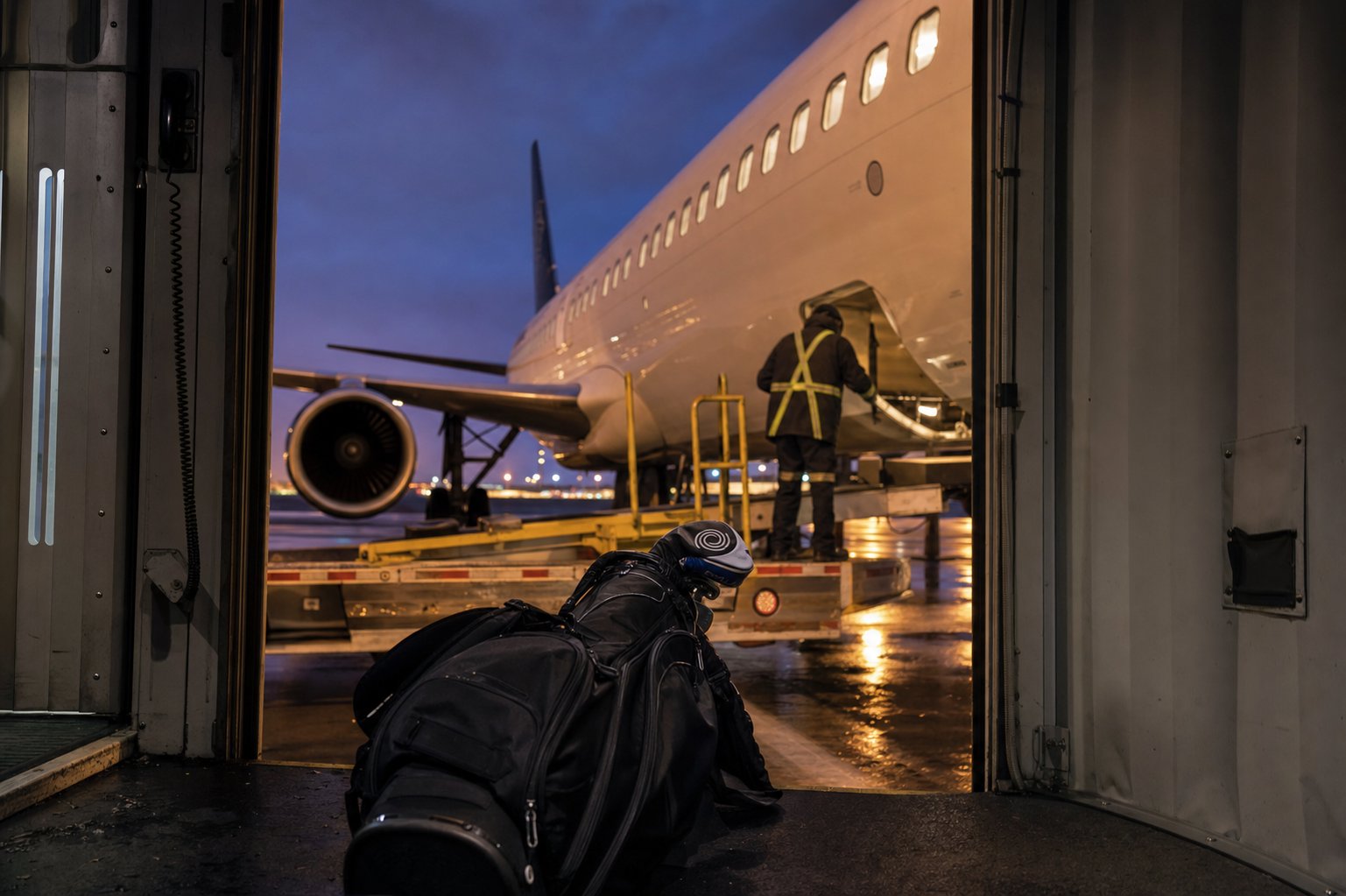
The scan takes exactly nine seconds. The bag tag beeps green at the counter. The clubs go down the conveyor. You do not see them again until you are standing at an oversized-baggage carousel two hours later, sometimes three, in a terminal that is not the one where you started. That is if you see them at all. In the aggregate, the numbers are fine. In the specific, for the traveler standing at Bandon or Kiawah or Bethpage without their driver, the numbers do not matter.
This is a piece about what happens between the bag drop and the carousel. It is a piece about the specific arithmetic of gate-checking a $2,800 set of clubs against a $4,700 liability ceiling, in a soft-shell travel bag most airlines will not fully insure, on a summer travel day in the busiest year for domestic golf tourism in the sport’s modern history. It is also, quietly, a piece about why touring professionals stopped flying with their sticks and started shipping them.
What the tour learned first
In June 2025, Rory McIlroy flew from the US Open in North Carolina to the Irish Open in Straffan and his clubs did not make the connection (theScore). He is the number-one ranked golfer in the world. He was flying to a tournament he is contractually obligated to play. The airline lost his bag anyway.
He was in the best possible situation to lose them. His sponsor, TaylorMade, could rebuild his set overnight. His manager could call the tournament and the tour and get accommodations made. He had backup clubs he could borrow at the range. The rest of us do not have any of that. And yet what stayed with the golf press was not that McIlroy got his gear back the next day. It was that a top-ranked professional, flying to a mandatory event, could not get a bag of clubs off an airplane.
The McIlroy incident was not an outlier. In February 2024, Ben Griffin landed at LAX after the WM Phoenix Open, headed for the Genesis Invitational pro-am the next morning, and his clubs did not arrive with him. His caddie drove six hours to retrieve them from Phoenix and made it back to Riviera in time for the pro-am (Golf Digest). Michael Buttacavoli, a PGA Tour Latinoamerica player, arrived in Florida in June 2017 for a US Open sectional qualifier and had to withdraw from the qualifier because his clubs never came off the plane (Fox News). Viktor Hovland, in January 2022, made it to Hawaii for the Tournament of Champions and got his clubs back, but one arrived cracked (Golf News Net).
These are the traveler-cases we hear about because the traveler had a tournament tee time. Every one of them has a shadow cohort of ten thousand recreational golfers who lost their clubs on the same routes, on the same days, and never made the news.
The pros learned. Almost every touring professional now ships their gear commercially — through services like Ship Sticks or through their equipment sponsors’ logistics — and flies with a carry-on. The clubs go days ahead. The clubs arrive at the resort before the player does. This is not an abundance of caution. It is what every player who has ever missed a tee time because of an airline has decided is the only rational way to travel with something they cannot replace overnight.
The mishandling rate is not the story
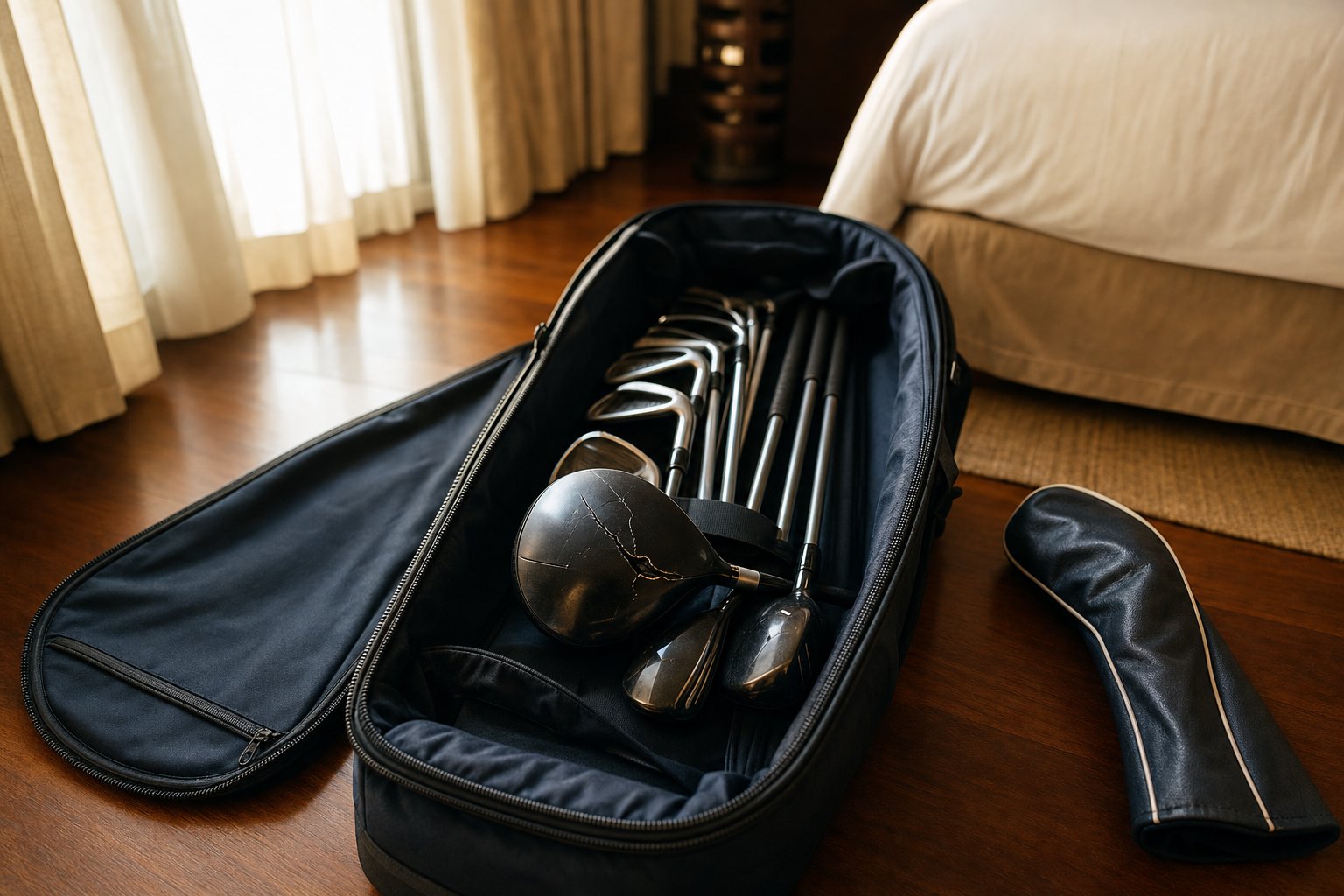
The industry likes to tell you that mishandling is rare. It is. In 2025, the US Department of Transportation reported that domestic carriers mishandled roughly 0.55 bags per 100 enplaned, which is one in every 180 or so (Baggage Finder). Global figures are broadly similar. This is meaningfully better than 2007, when the rate was roughly three times higher, and it is a genuine improvement driven by RFID and better airport tracking systems.
What the industry rate does not tell you is which bags. The two US carriers most likely to mishandle a bag are also the two carriers golfers most often fly on Sun Belt routes: United, with a 0.72 percent mishandling rate in 2025, and American, at 0.66 percent (Squaremouth). Those are network airlines with hub connections. Almost every golf trip from a northern city to a southern resort routes through a hub. Every additional connection multiplies the probability of a bag missing the flight.
And a golf bag is not a normal bag. It is oversized. It has to travel on separate belts. It goes to a separate carousel at arrival. It is loaded and unloaded on separate carts. Every one of those handling steps is an additional point where a bag can be misrouted or a club can be crushed. Anecdotally — every golf trip forum on the internet, every pro shop conversation, every caddie master’s story — golf bags disappear at multiples of the rate of standard checked luggage. The DOT does not break out mishandling by bag type, so no one has clean data. But the industry’s own words are telling: Golf.com writes plainly that “most airlines don’t compensate for damage, especially if you’re clubs are in a soft-covered travel bag.”
The $4,700 that does not really exist
Here is the number airlines want you to remember. On any domestic US flight, federal regulation caps a carrier’s liability at $4,700 per passenger (DOT). That is the maximum they must pay for a lost or damaged bag. It sounds like a lot. It is not a lot when your set of irons alone runs $1,400, your driver is a $600-plus flagship model, you have a $400 putter, and your bag itself was $350.
But the $4,700 ceiling is almost never what actually gets paid. Airlines reimburse for the depreciated value of the item, not the replacement cost, and only after you produce the original receipts, which most golfers do not keep for a set they built over three years. Every airline’s contract of carriage contains explicit exclusions for “fragile” items, which most of them define to include golf clubs in a soft-shell bag. If you check clubs in a soft-shell bag and one arrives cracked, the standard airline response, backed by the fine print in their liability schedule, is to deny the claim entirely.
| Scenario | Airline typically pays | You typically eat |
|---|---|---|
| Clubs delayed 24+ hours | Rental set, one sleeve of balls, one glove | The missed tee time. Any lesson booked. The value of the trip. |
| Cracked driver, soft-shell bag | Nothing. Denied under “fragile item” clause. | $500–$700 replacement, plus regripping. |
| Cracked driver, hard-shell case | Depreciated value, minus deductible, after 6–8 weeks | The difference between depreciated and replacement cost. |
| Complete set lost, never recovered | Up to $4,700, depreciated, receipts required | Whatever your set actually costs to replace at retail. |
| Complete set lost, international connection | Roughly $1,700 under Montreal Convention | Most of the actual value. |
Sources: DOT, individual carrier contracts of carriage, Golf.com. Domestic liability limit reflects the January 2025 DOT increase from $3,800 to $4,700.
The actual money at risk on a domestic golf trip with a decent set is closer to $3,000 in true replacement value. The most likely reimbursement in a damage scenario is zero. This is what the professionals figured out, and this is why they stopped taking the trip with their clubs.
The airline math nobody advertises
The other quiet fact of golf travel is that flying with your clubs is not cheap either. Not anymore.
A soft-shell golf travel bag over 50 pounds — which most full sets are, once you add shoes and balls — triggers oversized-baggage surcharges on every major US carrier. On American Airlines, an oversized bag costs $150 to $200 each way on domestic routes, which is $300 to $400 round trip on top of the standard checked-bag fee (Golf Club Rentals Florida). United and Delta price similarly. Southwest, which last year finally began charging for checked bags at all, treats a golf bag as one of your standard bags — first bag now $45 each way, or $90 round trip (Ship Sticks fee guide) — assuming you keep it under the weight and dimension limits.
Add it up. A typical domestic golf traveler in 2026, flying American to Scottsdale or Charleston with a bag of clubs plus a small carry-on, spends between $200 and $400 in checked-bag fees before the first tee ball. On budget carriers with more aggressive oversized policies, the total can crest $500.
You are already paying between $200 and $400 to check your clubs on most domestic flights. You are already accepting the risk of damage the airline will not cover. The only decision left is whether to keep doing both.
What shipping actually costs, and why it changed

Third-party golf-shipping services — Ship Sticks, Ship My Clubs, Sherpr, and increasingly Waylighter — have quietly become one of the most reliable growth categories in the travel industry. The reason is not because they are cheap. It is because they are approximately the same price as flying with the clubs, and they solve every problem the airline creates.
Rates in 2026 for a standard domestic golf-club shipment run between $60 and $180 each way door-to-door depending on route, lead time, and service level (Ship Golf Clubs). On a Chicago-to-Scottsdale route with three-day lead time, a ground shipment through a specialist service will typically land in the $60 to $80 range each way, or $120 to $160 round trip. On a New York-to-Bandon route with two-day service, it runs higher — $120 to $180 each way. Compare that to $300 to $400 round trip in airline oversized fees for the same route, plus the tail risk of damage.
The service level is the other half of the story. Airline check-in requires you to travel with your bag, arrive at the airport 90 minutes early because oversize checks take longer, wait at the oversized-baggage carousel on arrival (average wait: 40 minutes on major hubs), then load an oversized bag into a taxi or rental car. Third-party shipping picks the bag up at your home, tracks it end-to-end, and drops it at your resort or clubhouse concierge two days before your arrival. You fly with a carry-on. You get off the plane, order dinner, and go to bed knowing your clubs are already at the pro shop.
The insurance is different too. Reputable services include coverage in the $1,000 to $10,000 range depending on service tier, with the higher tiers written to match actual replacement value, not depreciated value. The claim process is designed for a package courier, not an airline, which means it resolves in days rather than weeks.
Who this decision is actually for
Not everyone. If you are flying Southwest to Orlando with a bag under the weight limit for $90 round trip, the airline math is close enough that the convenience argument becomes the entire decision. If you play a rental set at the resort anyway, this whole essay does not apply.
But if any of the following are true, the calculation has quietly shifted:
- You are flying on American, United, or Delta on a route that triggers oversized fees. You are already paying $300 to $400 round trip.
- Your set is worth more than $1,500 in current retail. You are risking meaningful replacement cost against a liability schedule that will not fully cover it.
- You are traveling to a bucket-list course where a missed tee time is not recoverable — Bandon, Cabot, Pinehurst, Ballybunion, Sand Valley.
- You are on a connection through a hub known for mishandling. Any US network carrier with a Sun Belt hub is a candidate.
- You have ever spent the first day of a golf trip at an oversized-baggage carousel instead of at the range.
Any two of those and the arithmetic starts to look like the arithmetic the pros already ran. Any three and the arithmetic is done.
The specific number, one more time
A traveler flying American Airlines from Newark to Phoenix in October 2026, checking a golf travel bag that weighs 48 pounds and containing a two-year-old set worth roughly $2,400, will pay $180 to $200 round trip in oversized-bag fees. They will accept, in exchange, the possibility that one of their clubs arrives cracked and the airline will decline the claim, the possibility that their entire bag arrives 24 hours late and they miss a tee time, and the certainty of a 40-minute wait at an oversized-baggage carousel on both ends of the trip.
The same traveler can ship the bag door-to-door for roughly $150 round trip on a three-day ground service, insured to $2,500, delivered directly to the resort concierge two days before arrival. They fly with a carry-on, walk off the plane, get in a rideshare, and arrive at the hotel to find their clubs already waiting at the bell stand.
These are two ways to spend approximately the same amount of money to move the same set of clubs the same distance. One of them is the way the touring pros travel. The other one is the way we all used to, before we knew what actually happens at the jet bridge.